The First Stage — From Source to Pipeline
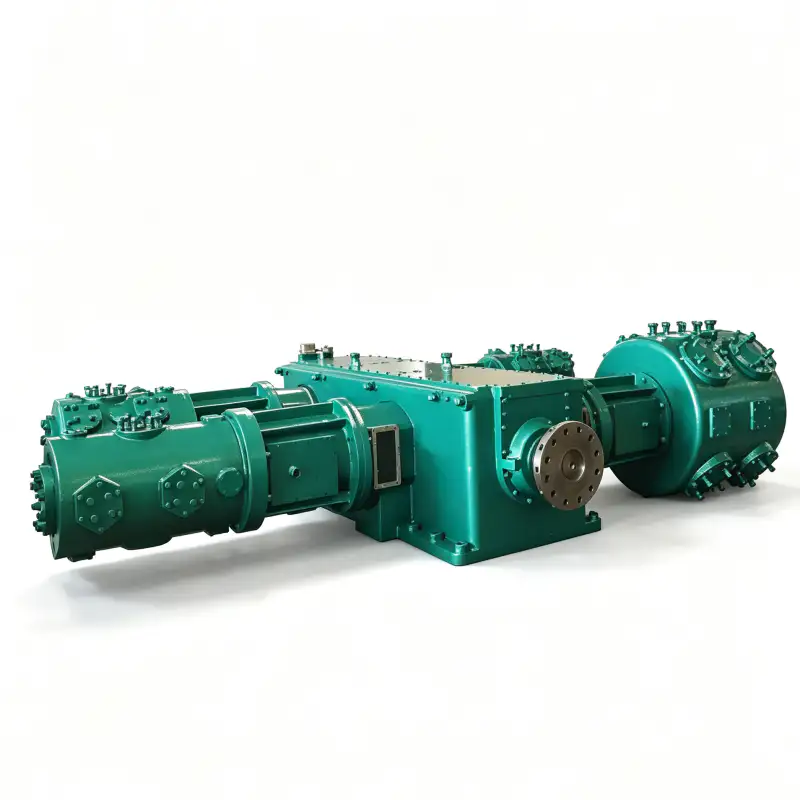
The D series is not a booster. It is the primary compression stage — the machine that takes oxygen directly from atmospheric pressure at the outlet of an air separation unit (ASU), PSA generator or liquid oxygen vaporiser, and raises it to the first working pressure of your oxygen distribution system: typically 2 to 8 bar (0.20–0.80 MPa).
This is the broadest product range in our catalogue — 21 models spanning from the ZW-0.7/6 (0.7 m³/min, 11 kW, 0.80 kg table-top scale) to the DW-150/4 (150 m³/min, 650 kW, 19 tonnes for a major integrated industrial complex). Every application that moves oxygen from a production source into a pipeline or process system starts here.
If your downstream process needs higher pressure — 10 bar for a PSA distribution header, 15 bar for laser cutting, or 30 bar for a steelmaking oxygen pipeline — the D series feeds into our C series (10–16 bar) या B series (30 bar) booster in a two-stage system.
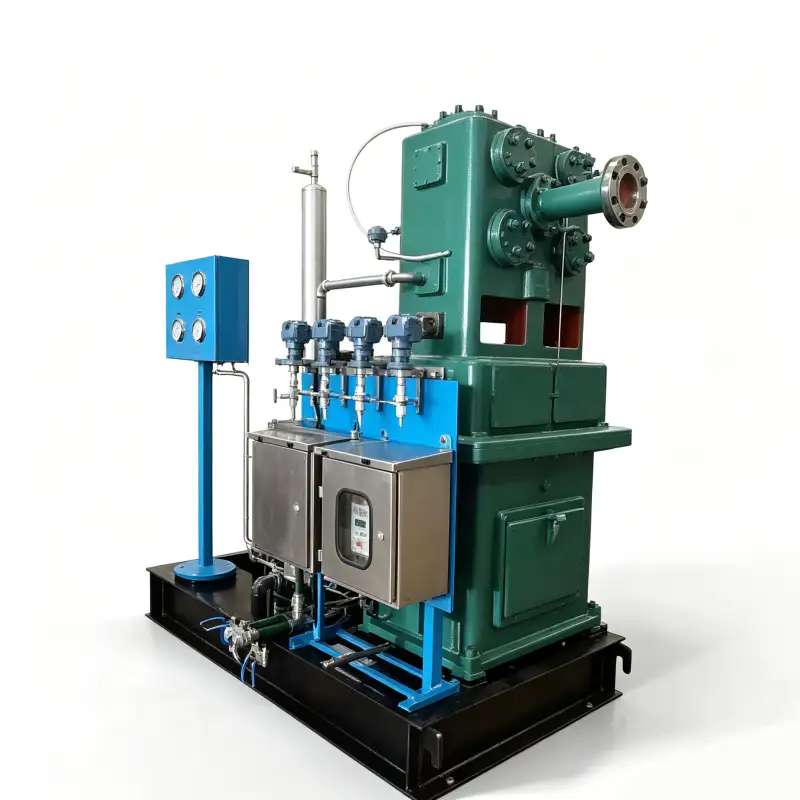
Full Model Parameters — D Series, 21 Models
Organised by outlet pressure group to simplify selection. All dimensions are reference values; confirm with engineering drawings before foundation design or space planning.
| Model | Flow (m³/min) | Outlet (MPa) | Stages | Motor (kW) | Weight (t) | L × W × H (mm) | Voltage |
|---|---|---|---|---|---|---|---|
| ZW-6/2 | 6 | 0.20 | 2-col / 2-stage | 30 | 2.0 | 2250×1865×2350 | 380V |
| LW-70/2 | 70 | 0.20 | 2-col / 1-stage | 250 | 5.0 | 3260×1655×2548 | 6kV / 10kV |
| LW-102/2 | 102 | 0.20 | 2-col / 1-stage | 350 | 6.2 | 3156×2465×2575 | 6kV / 10kV |
| LW-35/2.5 | 35 | 0.25 | 2-col / 1-stage | 132 | 3.4 | 3136×1550×2900 | 380V |
| LW-33/3 | 33 | 0.30 | 2-col / 1-stage | 132 | 3.4 | 3140×1550×2445 | 380V |
| DW-130/3.2 | 130 | 0.32 | 2-col / 2-stage | 600 | 13.5 | 5370×3540×2535 | 6kV / 10kV |
| Model | Flow (m³/min) | Outlet (MPa) | Stages | Motor (kW) | Weight (t) | L × W × H (mm) | Voltage |
|---|---|---|---|---|---|---|---|
| LW-30/3.5 | 30 | 0.35 | 2-col / 1-stage | 132 | 3.2 | 2926×1550×2690 | 380V |
| DW-105/3.5 | 105 | 0.35 | 2-col / 2-stage | 500 | 13.5 | 5840×3590×2928 | 6kV / 10kV |
| DW-150/4 | 150 | 0.40 | 2-col / 2-stage | 650 | 19.0 | 6000×3640×3000 | 6kV / 10kV |
| LW-13/5 | 13 | 0.50 | 2-col / 2-stage | 65 | 1.8 | 2340×910×2070 | 380V |
| Model | Flow (m³/min) | Outlet (MPa) | Stages | Motor (kW) | Weight (t) | L × W × H (mm) | Voltage |
|---|---|---|---|---|---|---|---|
| ZW-0.7/6 | 0.7 | 0.60 | 2-col / 2-stage | 11 | 0.8 | 1550×1320×1637 | 380V |
| LW-20/6 | 20 | 0.60 | 2-col / 2-stage | 132 | 3.0 | 2630×1550×2332 | 380V |
| LW-42/6 | 42 | 0.60 | 2-col / 2-stage | 240 | 4.5 | 3260×1655×2548 | 380V / 6kV / 10kV |
| DW-117/6 | 117 | 0.60 | 2-col / 2-stage | 630 | 14.0 | 6030×3590×2660 | 6kV / 10kV |
| Model | Flow (m³/min) | Outlet (MPa) | Stages | Motor (kW) | Weight (t) | L × W × H (mm) | Voltage |
|---|---|---|---|---|---|---|---|
| ZW-2/7 ★ | 2 | 0.70 | 2-col / 2-stage | 18.5 | 0.38 | 720×763×1475 | 380V |
| ZW-4.8/8 | 4.8 | 0.80 | 2-col / 2-stage | 37 | 2.0 | 2250×1296×2350 | 380V |
| ZW-5.3/8 | 5.3 | 0.80 | 2-col / 2-stage | 45 | 2.0 | 2250×1865×2350 | 380V |
| LW-10/8 | 10 | 0.80 | 2-col / 2-stage | 65 | 1.8 | 2340×910×2070 | 380V |
| DW-90/8 | 90 | 0.80 | 2-col / 2-stage | 550 | 13.0 | 5440×3518×2620 | 6kV / 10kV |
| DW-100/8 | 100 | 0.80 | 2-col / 2-stage | 600 | 13.0 | 5456×3518×2535 | 6kV / 10kV |
| 4MW-135/1.7~8 ★★ | 135 | 0.80 | 4-col / 2-stage | 1,200 | 26.0 | 6800×4000×3200 | 6kV / 10kV |
From 0.38 Tonnes to 26 Tonnes — One Platform
The D series spans a greater capacity range than any other product family in industrial oxygen compression. At one end, the ZW-2/7 weighs 0.38 tonnes and occupies a floor area smaller than a standard workbench — practical for a single-room laboratory or small clinic. At the other, the DW-150/4 delivers 150 m³/min at 19 tonnes — sized for a major air separation plant serving an integrated steelworks.
The engineering approach is consistent across the entire range: horizontal balanced opposed crankshaft, 1 or 2 compression stages, inter-stage cooling where applicable, and the same family of safety interlocks. This means the maintenance philosophy and spare parts logic are transferable regardless of machine size.
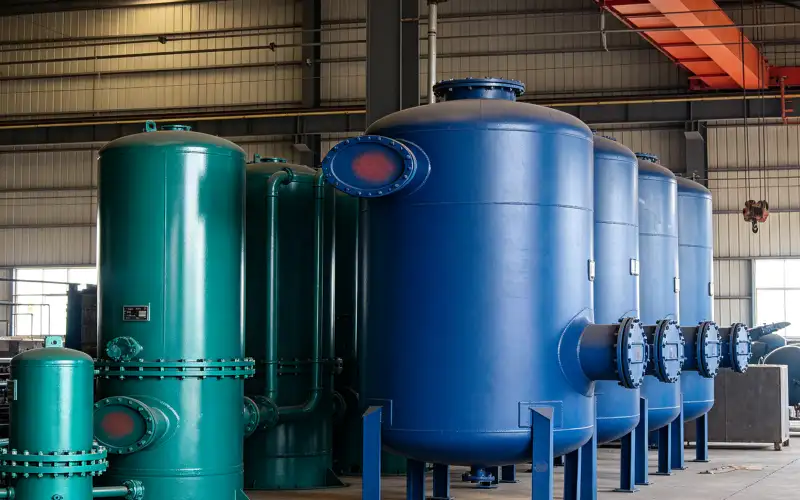
Four Primary Use Scenarios
Every oxygen system that moves gas from production to distribution passes through a primary compression stage. The D series covers all four main scenarios.
Cryogenic ASUs produce oxygen at low pressure — typically 0.1–0.4 MPa — which must be compressed before distribution. Large ASUs often require multiple compressors in parallel. The DW-150/4 (150 m³/min) and 4MW-135/1.7~8 (135 m³/min with pre-pressurised inlet) are sized for the largest industrial ASU applications. Smaller LW models serve medium-scale units.
PSA generators produce oxygen at 0.3–0.6 MPa — already slightly pressurised, but often requiring further compression to reach medical pipeline pressure (typically 4–6 bar) or industrial header pressure (6–8 bar). Medium LW models (LW-13/5, LW-20/6, LW-42/6) are the most common match for PSA system output across hospital, industrial gas and aquaculture applications.
High-density recirculating aquaculture systems (RAS) and intensive fish farms rely on continuous dissolved oxygen supplementation. On-site PSA generation paired with a D series compressor eliminates cylinder delivery costs and supply interruption risk. Small ZW and LW models (0.7–20 m³/min) are scaled for individual fish farm tanks and RAS circuits. The 6 bar (0.60 MPa) pressure range directly feeds underwater diffusers.
Where the target outlet pressure is above 8 bar, the D series acts as the first compression stage, raising oxygen from atmospheric to 6–8 bar, which then feeds a C series (10–16 bar) or B series (30 bar) booster. This staged approach keeps each machine at an efficient per-stage compression ratio rather than asking a single machine to cover the entire pressure range in one step.
Compliance You Can Document
DW series machines (13–19 t) and the 4MW-135 (26 t) require dedicated reinforced concrete foundations. We supply dynamic load data including piston force and unbalanced moments for your civil engineer. Please allow foundation design time in your project schedule.
Standard models are rated for sheltered indoor installation. Outdoor-rated and ATEX explosion-proof configurations (motor and instruments) are available on all models — specify at order placement. The ZW-9.5 outdoor version shown in product imagery is a typical example of this configuration.
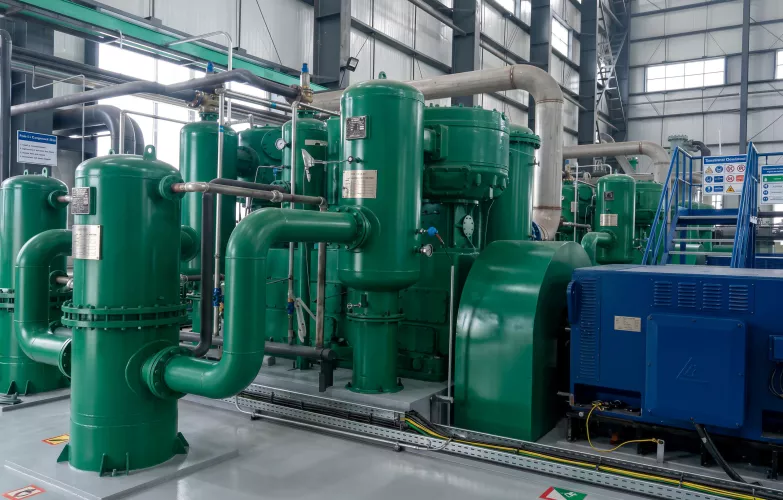
Common Questions
Complete Your System — Next-Stage Compression
Pair with D series output for laser cutting, glass furnace oxy-fuel and PSA medium-pressure distribution. 3–24 m³/min. 380V throughout.
Steel mill and industrial pipeline oxygen at 3.0 MPa. 4–100 m³/min. Second-stage machine fed by D or C series.
ZW series oil-free high-pressure filling machine. 60–300 Nm³/h. PSA-compatible. 150 bar or 165 bar.
One Supplier for the Complete Oxygen Compression Chain
Ever Power manufactures the full chain of reciprocating oxygen compressors — primary low-pressure (D series, 2–8 bar), medium-pressure boosters (C series, 10–16 bar), high-pressure boosters (B series, 30 bar) and cylinder filling machines (A series, 150–165 bar). A single supplier for every stage simplifies project coordination, spare parts management and technical support across the lifetime of your oxygen system.
All models are designed to API 618, manufactured in an ISO 9001 certified facility, and CE marked for European markets. Every machine is factory pressure-tested and performance-verified before shipment. We can provide a full documentation package for EPC and engineering contractor procurement.
Non-standard configurations — unusual inlet conditions, non-standard outlet pressure, ATEX rating, outdoor installation, VFD, or complete skid-mounted packages — are handled as routine orders. We build to your process requirements, not only to our standard catalogue.
To receive a model recommendation and pricing, please share your oxygen source type, outlet pressure requirement, required flow rate, power supply details and site conditions. We respond within one business day.