Hydrogen Cylinder Filling: The Same Platform, Different Engineering Decisions
When a gas distributor or industrial gas company adds hydrogen cylinder filling capability to an existing oxygen and nitrogen operation, the initial assumption is often that hydrogen filling is simply another gas on the same equipment. This assumption is partially correct — we do supply hydrogen cylinder filling compressors on the same ZW oil-free reciprocating platform as our oxygen and nitrogen machines — but it obscures several important engineering differences that must be addressed in the specification, material selection and operation of the equipment.
Hydrogen is uniquely challenging as a compression gas for three reasons: it has the smallest molecular size of any element, making it extremely prone to leakage; it causes hydrogen embrittlement in many steel grades at elevated pressures; and it forms a flammable mixture with air over a wide concentration range (4 to 75% v/v). None of these properties affect compression performance in the same way that, say, high molecular weight affects flow capacity — they affect material selection, sealing design, hazardous area classification, and building ventilation requirements.
This article covers the engineering decisions specific to hydrogen service, assuming the reader already understands the general principles of oil-free reciprocating compression covered in our earlier articles.
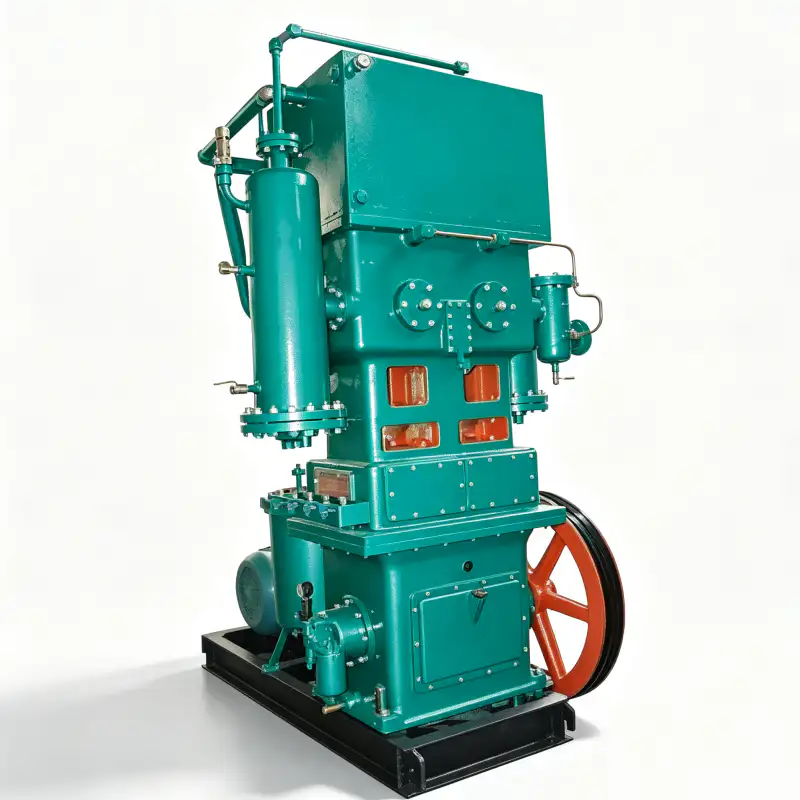
Why Hydrogen Embrittlement Matters in Cylinder Filling Applications
Hydrogen embrittlement is the process by which atomic hydrogen diffuses into the crystal lattice of steel and reduces its fracture toughness, ductility and fatigue strength. It occurs when steel is in contact with high-pressure molecular hydrogen, which dissociates into atomic hydrogen at the steel surface. Atomic hydrogen is small enough to diffuse into the steel microstructure.
The susceptibility of a given steel to hydrogen embrittlement depends on:
- Steel grade and strength level: Higher-strength steels are more susceptible — carbon steels above approximately 900 MPa tensile strength are considered at elevated risk. Standard pressure vessel carbon steels (e.g., SA-516 Grade 70 at approximately 485 MPa tensile strength) have relatively low susceptibility.
- Hydrogen pressure: Susceptibility increases with hydrogen partial pressure. At 150 bar (15 MPa), hydrogen embrittlement risk is significant for susceptible materials.
- Temperature: Room temperature and slightly above is the most critical range for hydrogen embrittlement. Very high or very low temperatures reduce the risk.
- Cyclic loading: Fatigue crack growth rates in hydrogen atmospheres can be significantly higher than in air for susceptible materials — important for components that experience pressure cycling during operation.
In a cylinder filling compressor, the components at greatest risk are: the final-stage cylinder body, the final-stage piston rod and packing, the discharge valve assembly, and the high-pressure discharge pipework. All of these must be specified in hydrogen-compatible materials.
Material Selection for Hydrogen Service
| Component | Oxygen / Nitrogen Service | Hydrogen Service Modification |
|---|---|---|
| Cylinder body | Cast iron or ductile iron | Ductile iron or low-carbon steel — verify fracture toughness |
| Piston rod | Stainless steel or hard-chrome carbon steel | Stainless steel preferred — austenitic grades have higher resistance to hydrogen embrittlement than martensitic |
| Valve components | Stainless steel plates, PEEK or stainless seats | Same — stainless steel is acceptable for hydrogen service |
| Piston rings | PTFE compound — dry running | PTFE — same material, confirmed compatible with H₂ |
| Rod packing seals | PTFE rings in carbon steel gland | PTFE rings — confirm elastomer backup material compatibility with H₂ |
| High-pressure pipework (final stage) | Carbon steel schedule 80 or higher | Carbon steel P265GH or equivalent — specify hydrogen-compatible per EN 13480 Part 4 or ASME B31.3 |
In practice, the material changes for hydrogen service are confined mainly to the final stage and discharge system, where pressures are highest. The first one to three stages, which operate at moderate pressures, use the same materials as the oxygen and nitrogen variants.
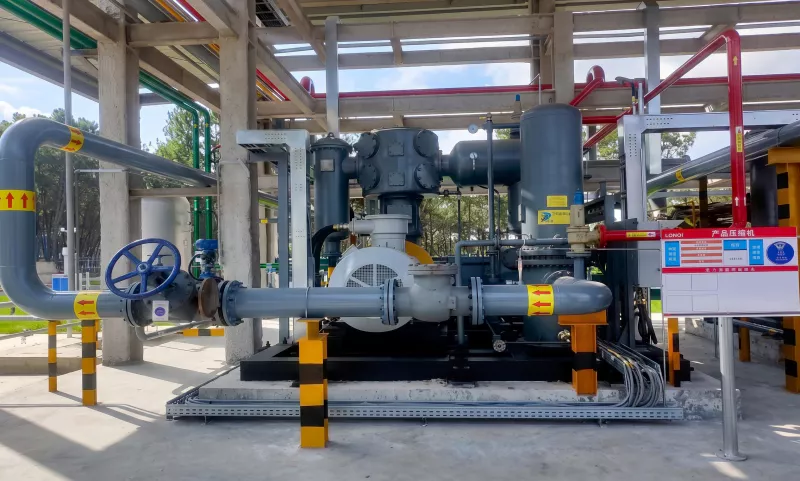
Sealing Design: The Leakage Challenge
Hydrogen molecules are approximately 14 times smaller than nitrogen molecules and have a viscosity approximately 7 times lower. These properties mean that hydrogen leaks through gaps that would be gas-tight to nitrogen or oxygen. In a reciprocating compressor, the critical sealing locations are:
- Piston rod packing: The seal between the compression cylinder and the distance piece. Hydrogen leakage past the rod packing vents through the distance piece vent — in hydrogen service, this vent must discharge to a safe location outside the building, not to the surrounding air inside the compressor room.
- Valve body flanges and covers: All static joints in the high-pressure system must use metal-to-metal sealing or PTFE-encapsulated metal gaskets. Standard compressed-fibre gaskets that perform well in oxygen and nitrogen service may allow unacceptable hydrogen leakage.
- Discharge pipework joints: Threaded connections are not recommended in hydrogen service above approximately 3 MPa. Welded or flanged connections with metal ring gaskets are preferred.
- Instrumentation connections: All pressure gauge and transmitter connections in the high-pressure section should be welded or use metal-seated tube fittings (Swagelok or equivalent) rather than pipe threads.
Hazardous Area Classification and Ventilation
Hydrogen forms a flammable mixture with air at concentrations between 4% and 75% v/v. This wide flammability range means that even a small leak can create a flammable atmosphere. Any space that contains hydrogen compression equipment must be classified as a hazardous area and designed accordingly.
Typical classification for a hydrogen cylinder filling compressor room:
- Zone 1 (according to IEC 60079-10-1): The space within 1 metre of any hydrogen gas-path joint or potential leak point — including the compressor discharge connection, valve covers, and distance piece vent outlet
- Zone 2: The general interior of the compressor room, assuming adequate ventilation (typically 12 air changes per hour minimum)
All electrical equipment installed in the compressor room must be selected for the zone classification. Our compressor motors and control panels for hydrogen service are specified as ATEX Zone 1 or Zone 2 as appropriate, with Ex d (flameproof) or Ex e (increased safety) enclosures.
Ventilation is mandatory. The compressor room must be mechanically ventilated with air supply at low level and exhaust at high level (hydrogen is lighter than air and accumulates at ceiling level). A hydrogen gas detector with audible and visual alarm and automatic fan activation should be installed at ceiling level. Some national regulations also require automatic compressor shutdown on high hydrogen concentration alarm.
Oil-Free Operation: The Same Requirement, Different Reasoning
For oxygen, oil-free compression is required because oil contamination creates a fire and explosion risk in the presence of high-pressure oxygen. For hydrogen, the reasoning is different but the conclusion is the same.
Hydrogen purity requirements for the most demanding downstream applications — fuel cell supply, hydrogenation reactors, semiconductor manufacturing, calibration gas — specify total oil content of less than 0.01 mg/m³ (ISO 8573-1 Class 0). Oil contamination in hydrogen also damages:
- Fuel cell membrane electrode assemblies (MEA): Even trace oil deposits on the proton exchange membrane permanently reduce cell efficiency and lifetime
- Catalysts in hydrogenation reactors: Oil poisons the active sites on supported metal catalysts, causing irreversible deactivation
- Calibration gas accuracy: Oil contamination of a hydrogen calibration mixture changes its composition and invalidates its certification
Our ZW series hydrogen filling compressors use PTFE dry-running piston rings in all stages, with the same distance-piece separation design as the oxygen variants. The output hydrogen meets ISO 8573-1 Class 0 oil content without downstream filtration.
Comparison: Oxygen vs Nitrogen vs Hydrogen Cylinder Filling
| Parameter | Oxygen Filling | Nitrogen Filling | Hydrogen Filling |
|---|---|---|---|
| Fill pressure | 150 or 165 bar | 150 or 165 bar | 150 bar (standard) |
| Oil-free required? | Yes — safety | Recommended — purity | Yes — purity |
| Material special selection? | Oxygen-service cleaning critical | Standard | Hydrogen embrittlement risk |
| Hazardous area classification? | Oxygen-enriched atmosphere | Standard industrial | Zone 1/2 — flammable |
| Ventilation requirement? | Oxygen enrichment monitoring | Standard | Forced ventilation + H₂ detector |
| Sealing standard? | Oil-free, no hydrocarbon residue | Standard | Hydrogen-grade seals, welded joints preferred |
| Shared platform possible? | Yes (with O₂/N₂) | Yes (with O₂/H₂) | Separate machine recommended |
Can the Same Compressor Fill Oxygen and Hydrogen?
Technically, the same physical machine can be configured for either gas at the factory — but we do not recommend using a single compressor to fill both oxygen and hydrogen cylinders. The reasons are practical:
- Gas line changeover between oxygen and hydrogen requires a full purge and nitrogen sweep of all gas-contact surfaces — a time-consuming procedure that creates operational complexity
- Oxygen and hydrogen cylinders must be filled in separate rooms with different safety classifications — using the same compressor in both rooms requires moving the machine or running long discharge lines
- The risk of cross-contamination between oxygen and hydrogen — even in trace amounts — is unacceptable: a hydrogen-contaminated oxygen cylinder represents a serious explosion risk
We supply dedicated compressors for each gas, sharing the same ZW platform and many common components, but configured and cleaned specifically for the intended gas service.
To discuss hydrogen cylinder filling compressor specification, visit our nitrogen and hydrogen cylinder filling compressor page or contact our engineering team with your process data.